
You've probably tried a word search app, a daily puzzle, maybe a brain training subscription that promised sharper focus in ten minutes a day. Most of them test something you're already decent at: recognizing whole words fast. That's not a weakness worth training. The actual gap for most people — kids doing geometry homework, adults staring blankly at a spec diagram, typists losing accuracy under pressure — is mental rotation: the ability to hold a shape in your head and turn it until it matches something else. Letter Flip Challenge, the game inside UntangleTools' Brain Rotate section, is built around exactly that gap instead of around vocabulary.
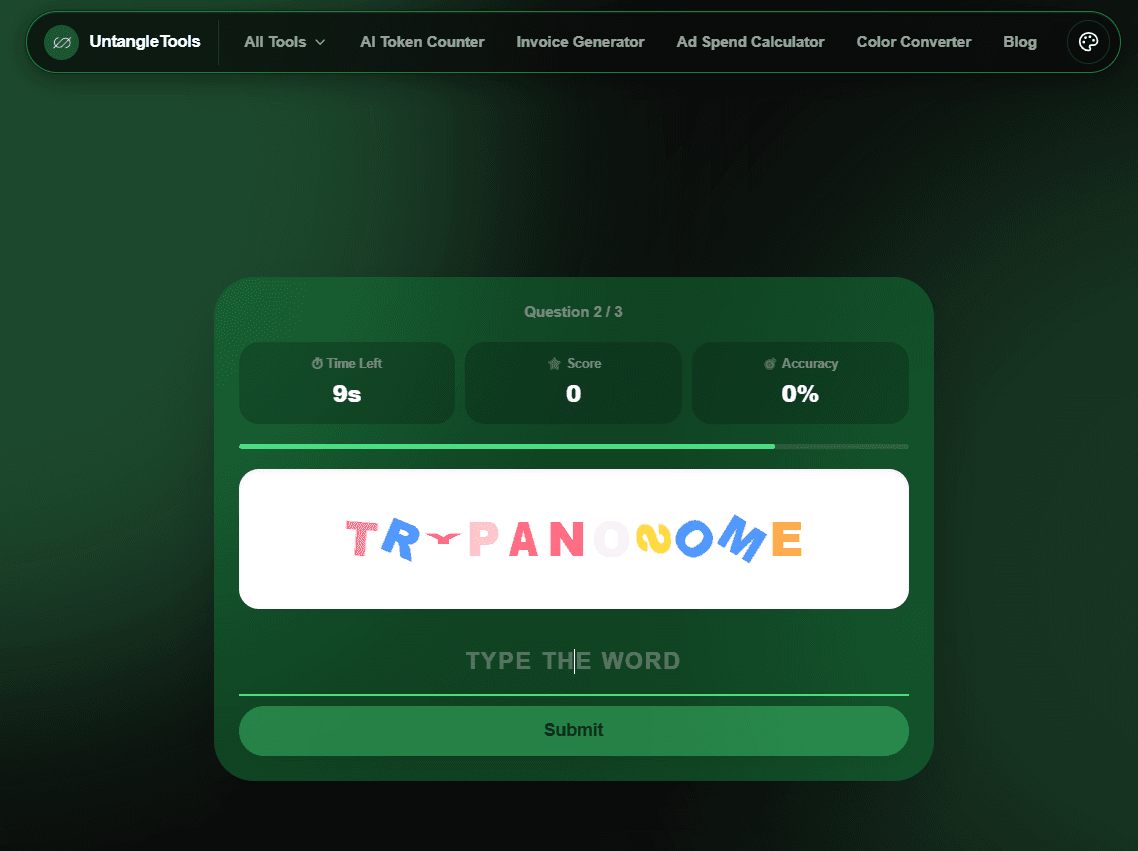
The premise is simple to state and surprisingly hard to do well. Take a word, a sentence, or a paragraph. Rotate each letter, mirror it, or fade it out mid-round. Then ask the player to type exactly what the undistorted text says. No multiple choice, no hints beyond a short context clue. You either decode it or you don't.
What the Letter Flip Challenge Actually Is
Letter Flip Challenge is a free, browser-based typing and word-recognition game where every letter gets rotated, mirrored, or faded before you type it. It runs entirely client-side, so a round starts the moment you hit play — no account, no download, no loading screen. You can try it directly at:
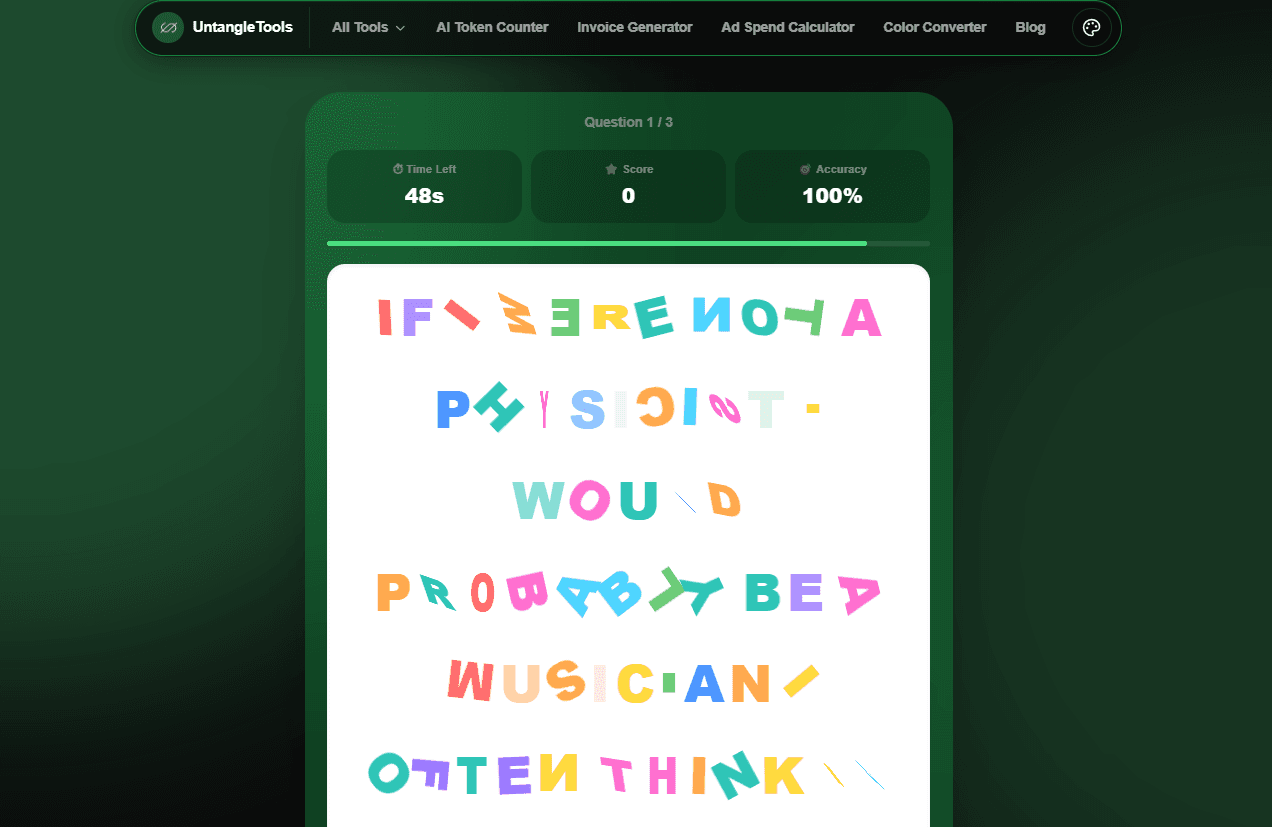
What separates it from a typical word scramble is the axis of distortion. Scrambling a word changes the order of its letters — C-A-T becomes A-T-C. That mostly tests sequencing memory. Rotation changes the orientation of each letter while keeping the order intact, which forces a completely different kind of processing: you have to mentally spin the shape back to its correct position before you even know what letter you're looking at. It's a small distinction that changes which part of the brain does the work.
Why Rotating Letters Breaks Autopilot Reading
Fluent readers don't process text letter by letter — or at least, that's the popular belief. Eye-tracking research says otherwise. Studies going back over two decades show that during normal reading, the eye fixates on most content words in a rapid sequence of stops and jumps, taking in roughly seven to nine letters to the right of each fixation point and three to four to the left, rather than recognizing whole shapes at a glance. Rotation exploits this directly: once a letter's orientation is unfamiliar, the shortcut readers rely on stops working, and the brain has to fall back on slower, deliberate identification of each character before it can reassemble the word.
That slower mode isn't a downgrade. It's the same deliberate-reasoning circuitry used in mental rotation tasks — the classic cognitive-psychology paradigm where you're shown an object and asked to judge whether a second, rotated view matches it. Research on mental rotation training is where this gets genuinely interesting for parents and teachers. A multisession study combining eye-tracking and brain-imaging data found that people who trained specifically on mental rotation tasks improved measurably more than a matched control group, and that most of the gain came from better encoding of the object's shape in memory, not just faster guessing on repeated trials. Mental rotation itself shows up constantly outside the lab too, in everyday tasks like reading a map, packing a suitcase, or figuring out how a diagram fits together, and researchers have linked stronger mental-rotation performance to general problem-solving ability and better outcomes in STEM-heavy fields and professions.
That's the honest pitch for why a word game like this earns a spot in a daily routine: it isn't just a novelty distortion effect, it's practicing a specific, transferable cognitive skill under a fun, low-stakes wrapper.
How to Use Letter Flip Challenge, Step by Step
Setup takes under a minute, but the six choices you make before hitting start are what decide whether a round actually trains something or just feels like a fidget toy. Here's the sequence, walked through screen by screen.
Step 1: Pick a difficulty that matches your warm-up, not your ego
Easy uses common vocabulary with rotations kept under 45 degrees, gentle enough that the underlying shape is still mostly recognizable. Medium sharpens both the rotation angle and the vocabulary. Hard stacks full 90-degree rotations and mirror flips onto longer sentences or full paragraphs — and that's a different kind of hard than simply harder words, since it's compounding distortions on top of each other rather than just picking longer text.
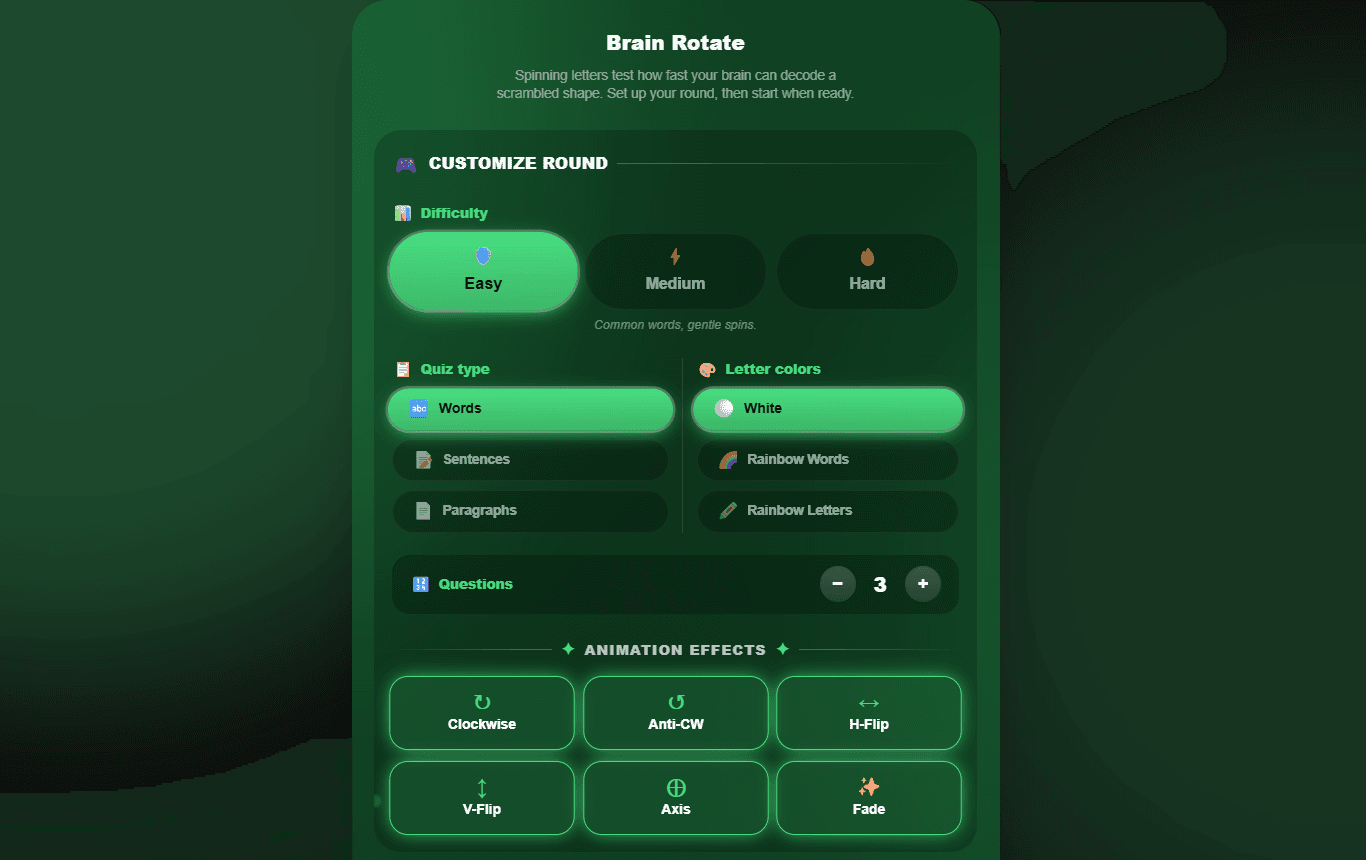
Step 2: Choose a quiz type based on what you actually want to train
Words isolates raw shape recognition — one distorted word, one answer. Sentences adds word order and short-term grammar memory on top of the rotation task itself. Paragraphs is the endurance mode: it pushes reading stamina across several distorted lines at once instead of a single isolated word, which is a genuinely different skill than solving one word cold.
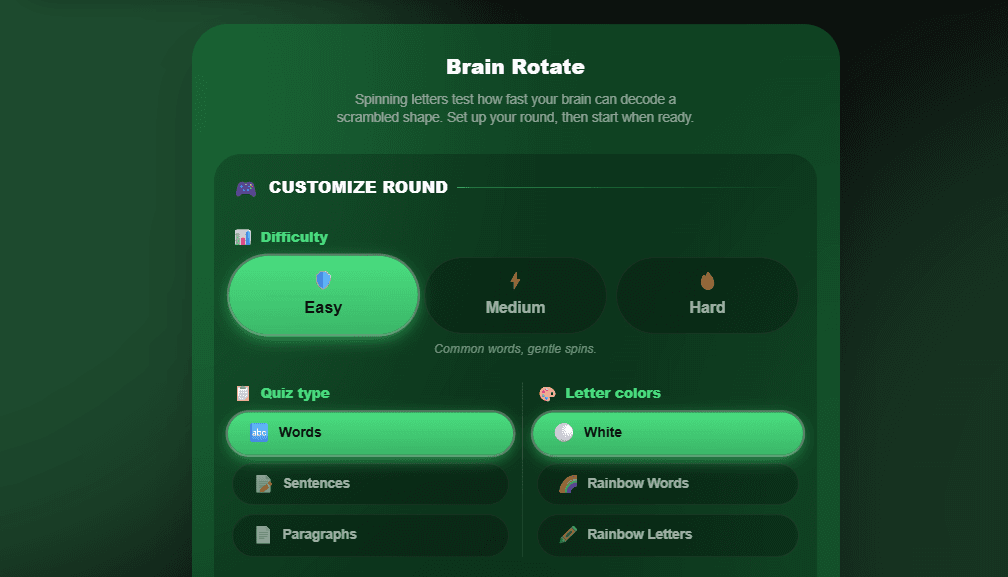
Step 3: Set letter color to control how much visual noise competes for your attention
White keeps every letter neutral, isolating shape and rotation as the only variables in play — this is the setting to use if you actually want to track improvement over time, since nothing else is competing for attention. Rainbow Words adds one color cue per word, a mild assist. Rainbow Letters is the hardest color mode, because every individual letter competes for attention on its own, layered on top of the rotation itself.
Step 4: Set a question count that matches the time you actually have
Three questions works fine as a warm-up wedged between tasks. Ten or more turns it into a genuine focus block for someone who wants a longer reset. Neither option is more correct than the other — it depends entirely on whether you're grabbing sixty seconds between meetings or sitting down for a deliberate session.
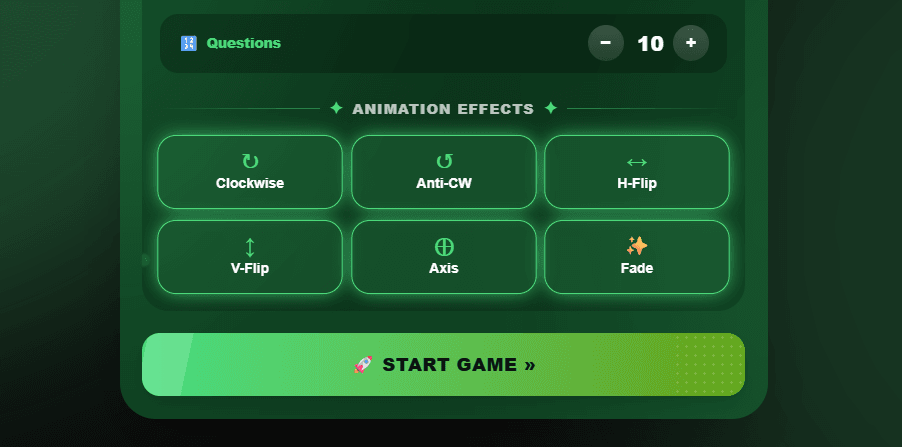
Step 5: Layer animation effects — this is where the real difficulty lives
Clockwise, Anti-CW, H-Flip, V-Flip, Axis, and Fade can each run alone or get stacked together on the same word. A single Clockwise rotation is a gentle starting point. Stack an H-Flip and an Axis reflection onto the same five-letter word, though, and the difficulty jumps well past what the base difficulty label suggests — because, as the Distortion Score below shows, flips compound spatial confusion faster than rotation angle by itself.
The Distortion Score: How Difficulty Is Actually Calculated
Most word games hide their difficulty logic behind a vague label like hard with no explanation. Letter Flip Challenge's difficulty is simple enough to estimate in your head before a round even starts, using this formula:
Distortion Score = (Rotation° ÷ 90) + (Flip Count × 1.5) + (Word Length ÷ 4)
A five-letter word rotated 45 degrees with a single flip lands around 2.4 — solidly Easy. Add a second flip and push the rotation to a full 90 degrees on an eight-letter word, and the score clears 5, which is where Hard mode actually lives. The jump between Medium and Hard feels disproportionate for a reason: flips compound spatial confusion faster than rotation angle alone does.
Each animation effect stresses a slightly different mental muscle:
| Effect | What it tests | Best for |
|---|---|---|
| Clockwise | Standard forward mental rotation, the most practiced direction from everyday reading | Warm-up rounds, first-time players |
| Anti-CW | The same rotation reversed — most players are measurably slower here | Building rotational flexibility once Clockwise feels easy |
| H-Flip | Left-right mirroring, the same visual territory as b/d and p/q confusion | Anyone working on letter-reversal habits |
| V-Flip | Top-to-bottom inversion, easier to spot but harder on longer words | Medium rounds once basic rotation is comfortable |
| Axis | A diagonal reflection combining rotation and mirroring in one move | Medium and Hard rounds only |
| Fade | No shape distortion — letters vanish mid-read | Working memory practice rather than spatial rotation |
Fade is worth calling out separately because it trips people up. It doesn't touch letter shape at all, so on paper it should feel easier than rotation. It doesn't. Removing letters from view mid-round shifts the task from spatial reasoning to short-term memory, and those are genuinely different skills — which is exactly why stacking Fade with something like Rainbow Letters is a favorite combination among competitive typists chasing a harder input-accuracy drill.
Who This Game Is Actually Built For
The honest answer is: a wider range of people than most single-purpose brain games manage, because the difficulty knob does real work instead of just changing word length.
A parent running one Easy, three-question round with their kid right before geometry homework is warming up the exact same mental-rotation muscle the homework needs, at much lower stakes than the homework itself. A teacher pulling up Medium mode on a classroom projector gets a ninety-second attention reset between subjects — short enough not to eat into a lesson plan, distinct enough to actually shift focus. An English learner can treat the short context hint that ships with every word as a lightweight definition check, layering vocabulary practice on top of the spatial task. And a remote team running one Hard, paragraph-mode round between back-to-back calls gets something closer to an actual cognitive reset than another five minutes scrolling a phone.
Spatial reasoning is what lets you read a map and navigate an unfamiliar city, pack a suitcase efficiently, understand how a machine works from a diagram, or predict how an object looks from a different angle — and the encouraging part of the research is that this ability responds to practice. Mental rotation speed, spatial visualization accuracy, and spatial working memory have all been shown to improve significantly with targeted practice, which is a stronger evidence base than most casual game-based cognitive claims can point to.
One thing worth being direct about: this is a supporting exercise, not a replacement for direct instruction. If a kid is genuinely struggling with geometry, five minutes of Letter Flip Challenge won't substitute for a tutor working through the actual proofs. Treat it as a warm-up for the mental machinery, not the machinery itself.
Letter Flip Challenge vs. Generic Brain-Training Apps
| Approach | What it actually trains | Setup required | Best for |
|---|---|---|---|
| Letter Flip Challenge | Mental rotation, mirror-symmetry discrimination, working memory (Fade mode) | None — browser-based, no signup | Quick resets, classroom warm-ups, typing accuracy drills |
| Subscription brain-training apps | Broad mix of memory, math, and pattern games, often gamified with streaks | Account creation, usually a paid tier for full library | Long-term structured programs across many cognitive domains |
| Standard word scrambles | Letter-order sequencing and vocabulary recall | None | Vocabulary building, casual downtime |
| Physical mental-rotation flashcards | Same 3D object-rotation skill used in the classic Shepard-Metzler paradigm | Printed materials or a dedicated app | STEM classrooms specifically targeting spatial visualization curricula |
The honest trade-off: Letter Flip Challenge is narrower than a full brain-training suite by design. It doesn't try to cover memory, math fluency, and reaction time in one app. What it does, it does with almost no friction — no account wall, no upsell screen between rounds — which matters more than people expect when the whole point is a two-minute reset, not a twenty-minute session.
The Mistake Most New Players Make
New players almost always try to decode a rotated word the same way they read normally — left to right, letter by letter, in order. That's the slowest possible approach, and it's also the approach most likely to produce a wrong guess under time pressure, because early errors compound as you go.
The fix experienced players land on eventually is what's worth calling the anchor letter trick: instead of starting from the first letter, scan the whole word for one letter with a distinctive stroke that stays recognizable even when rotated — R, K, and G are common examples, since their asymmetric shapes don't collapse into ambiguity the way something like O or I can. Lock that letter's identity first, then mentally rotate the rest of the word around it rather than starting cold on every character. It sounds like a small change in strategy. In practice it's the single biggest lever for cutting solve time once the basic shape-recognition reflex kicks in.
Quick takeaways before you start a round
- Rotation and mirroring test a different skill than scrambling — spatial reasoning, not sequencing
- White letter color isolates rotation as the only variable, which is the mode to use if you want to track real improvement
- Distortion Score = (Rotation° ÷ 90) + (Flip Count × 1.5) + (Word Length ÷ 4) — flips add difficulty faster than angle does
- Fade mode tests working memory, not spatial rotation, which is why it feels harder than it looks
- The anchor letter trick (locking one distinctive letter first) is the fastest way to cut solve time
Questions People Actually Ask
Is a rotated-letter game actually different from a normal word scramble?
Yes, and the difference isn't cosmetic. A scramble reorders letters, which mostly tests sequencing memory — can you reassemble a known set of letters into the right order. Rotation keeps the order intact but changes each letter's orientation, which forces mental rotation instead, the same spatial-reasoning skill used in geometry and engineering diagrams.
What age is Letter Flip Challenge appropriate for?
Easy mode works well from around age seven, once a child is reading fluently enough that the underlying word is familiar even when distorted. Medium and Hard suit older students, teens, and adults who want a sharper cognitive warm-up rather than a beginner introduction.
Does playing this actually help with math or geometry?
It trains the same mental-rotation reflex that geometry and engineering diagrams rely on, and that reflex is measurably trainable with practice. It's a supporting exercise that warms up spatial-reasoning circuitry, not a substitute for direct math instruction or problem sets.
Why does Fade mode feel harder than the rotation modes, even though nothing is distorted?
Fade removes letters from view partway through the round instead of changing their shape, which shifts the challenge from spatial rotation to short-term memory. Those are genuinely different cognitive tasks, so a player who's fast at decoding rotated shapes can still struggle with Fade specifically.
Can I make a round harder without just picking Hard difficulty?
Yes — difficulty, quiz type, letter color, question count, and animation effects are all independent settings. Stacking multiple animation effects on one round (say, Axis plus Fade) raises the Distortion Score more than bumping the base difficulty alone, since flips and memory load compound faster than rotation angle by itself.
Does it work on a phone, or is it built mainly for desktop?
It's built mobile-first, so every setting — difficulty, quiz type, animation choice — is touch-friendly on a phone or tablet, not a scaled-down desktop layout.
If you're deciding whether this is worth five minutes of your day: the research on mental rotation training is genuinely more solid than the evidence behind most casual brain game claims, and this version of the exercise doesn't ask for an account, a subscription, or your email before you get a single round in. Start on Easy with Words and white letters to get a feel for the shape-recognition reflex, then push toward Paragraphs and stacked animation effects once the anchor letter trick clicks. That's the actual progression that turns this from a novelty into a habit worth keeping. Try it yourself at: